
Central Monitoring System
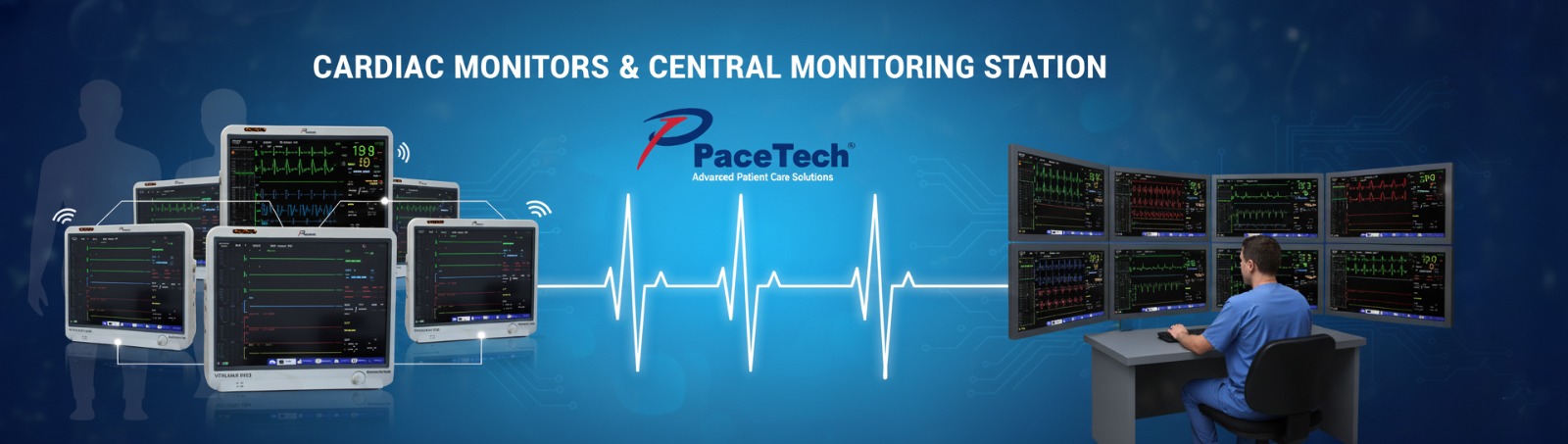
A Central Monitoring System (CMS) is designed to work as the perfect companion for patient monitors in hospitals. It allows medical staff to observe multiple patients from a single workstation, making monitoring easier, faster, and more efficient.
This system is ideal for Intensive Care Units (ICU), emergency departments, and general wards where continuous patient observation is critical. By collecting and displaying real-time data from several bedside monitors, the CMS ensures that doctors and nurses always have instant access to vital patient information.
Key Features
- Multi-Bed Monitoring: View and monitor data from up to 64 patient beds simultaneously from one station.
- Comprehensive Vital Signs Monitoring: The system displays important patient parameters including:
- Blood Pressure (BP)
- Pulse Rate (PR)
- Oxygen Saturation (SpO₂)
- Electrocardiogram (ECG)
- Respiration (RESP)
- Temperature (TEMP)
- Invasive Blood Pressure (IBP)
- End-Tidal CO₂ (EtCO₂)
- Real-Time Patient Data: All patient information is displayed instantly, allowing quick clinical decisions.
- Alarm Management: Supports physiological alarms and technical alarms to alert medical staff in case of abnormalities.
- Data Storage & Recall: Historical patient data can be easily retrieved for review and analysis.
- Report & Data Output: Monitoring reports can be exported or printed for documentation and medical records.
System Connectivity
The Central Monitoring System connects patient monitors through a hospital network, enabling seamless data communication.
- Bedside monitors are connected to the network using Ethernet cables.
- The CMS workstation can access the network wirelessly or through a wired connection.
- A wired or wireless router can be used to establish the monitoring network.
This network setup ensures reliable and stable communication between the CMS and patient monitors.
Technical Specifications (System Requirements)
| Component | Minimum Requirement | Recommended Configuration |
|---|---|---|
| CPU | Mainstream CPU | Dual-Core CPU |
| Display | 1280 × 1024 resolution monitor | 1280 × 1024 TFT LCD |
| RAM | 1 GB | 2 GB |
| Graphics Card | 256 MB | 256 MB or higher |
| Hard Disk | 80 GB | 160 GB or higher |
| Audio | Compatible sound card & speakers | Compatible sound card & speakers |
| Printer | Optional 600 DPI inkjet or laser printer | 600 DPI or higher inkjet/laser printer |
| Network | Ethernet connection | Wired or Wireless Router |
Applications
The Central Monitoring System is widely used in hospital environments where multiple patients need to be monitored continuously.
- Intensive Care Units (ICU)
- Coronary Care Units (CCU)
- Emergency Departments
- General Hospital Wards
- Post-Operative Monitoring Areas
By centralizing patient monitoring, the CMS helps healthcare professionals respond faster to patient needs and improve overall clinical efficiency.